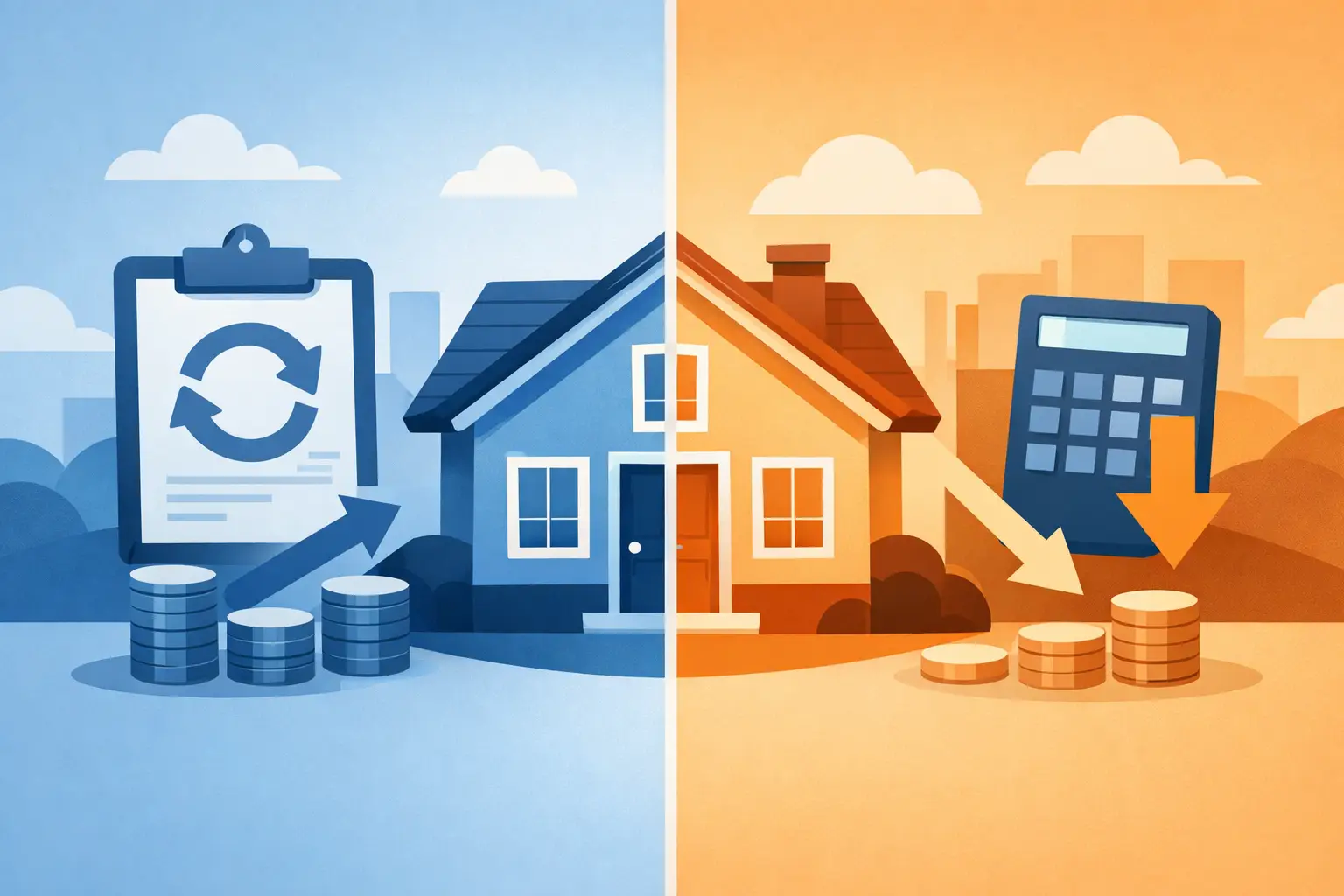
A large bonus, inheritance, or home-sale proceeds can create a good problem: you have cash to put toward your mortgage. But before sending it in, understand the difference between refinance versus loan recast. Both can lower your monthly payment in the right situation, but they work very differently – and choosing the wrong one can cost more than it saves.
A recast keeps your current mortgage in place and recalculates the payment after a substantial principal payment. A refinance replaces your existing loan with a new one. The better choice depends on your interest rate, loan term, cash position, and what you want your money to accomplish next.
What Is a Loan Recast?
A loan recast, sometimes called a mortgage re-amortization, begins with a lump-sum payment toward your principal balance. Once that payment is applied, your loan servicer recalculates the monthly principal and interest payment based on the smaller balance and the time remaining on your original loan.
Your interest rate does not change. Your loan term does not restart. If you have 22 years left on a 30-year mortgage, you will still have 22 years left after the recast. You simply owe less, so the required monthly payment is lower.
For example, imagine you have a $350,000 balance, a 3.25% fixed rate, and 25 years remaining. If you apply $75,000 to the principal and your servicer allows a recast, the new payment may fall meaningfully. The exact reduction depends on your balance, rate, and remaining term, but the key point is that you preserve a rate that may be hard to replace in a higher-rate market.
Recasting usually involves a modest administrative fee, often a few hundred dollars, plus a lender or servicer minimum for the lump-sum principal payment. Not every mortgage can be recast. Many conventional loans may qualify, while FHA, VA, USDA, and certain portfolio loans often follow different rules. Your loan servicer can confirm eligibility.
What Is a Mortgage Refinance?
A refinance pays off your current mortgage and replaces it with a brand-new loan. You apply, provide income and asset documentation, meet credit and underwriting requirements, and close on the new mortgage. Depending on the program and your situation, an appraisal may also be required.
The primary reason to refinance is to change a major part of the loan. You may want a lower interest rate, a shorter repayment term, a fixed rate instead of an adjustable rate, or cash from your equity. You can also refinance to remove a borrower, such as after a divorce, or potentially eliminate mortgage insurance if your equity and loan program allow it.
Unlike recasting, refinancing comes with closing costs. Those may include lender fees, title charges, prepaid items, and other transaction costs. Sometimes costs can be rolled into the new loan balance or offset through lender credits, but they do not disappear. The right way to evaluate a refinance is to compare the total financial picture, not just the advertised rate or the new payment.
Refinance Versus Loan Recast: The Core Differences
The most meaningful difference is simple: a recast changes your payment after you bring cash to the table, while a refinance changes the structure of your mortgage.
A recast is usually faster and less expensive. There is generally no new loan application, full underwriting process, or closing table. It can be a strong option for a homeowner who recently sold another property, received a sizable sum, or made a large down payment after buying with a temporary financing strategy.
A refinance takes more work and costs more upfront, but it gives you more control. You can choose a new term, pursue a different interest rate, move from an adjustable-rate mortgage to a fixed-rate loan, or access equity through a cash-out refinance. Those are outcomes a recast cannot provide.
There is also an important distinction in total interest. Because a recast keeps the same end date, it does not stretch the debt over a new 30-year term. Refinancing into a fresh 30-year loan can lower the payment, but it may also increase the total interest you pay over time if you keep that loan for the full term. A shorter-term refinance can move in the opposite direction: the payment may rise, while total interest falls.
When a Loan Recast May Make Sense
A recast may fit when you already have a favorable interest rate and want a lower required payment without replacing the loan. This is especially relevant for homeowners who locked in rates well below current market rates.
It can also be useful after you purchase a new home before selling your previous one. Once the prior home sells, you may use some proceeds to reduce the new mortgage balance and request a recast. The lower payment can create more room in your monthly budget while keeping the original financing intact.
A recast is not always the best use of extra cash. Before making a large principal payment, consider whether you have an adequate emergency fund, higher-interest debt, upcoming home repairs, or other financial priorities. Money applied to your mortgage is no longer readily available without borrowing against the home again.
Questions to Ask Before Recasting
Start by confirming whether your loan is eligible and what minimum principal payment your servicer requires. Ask about the recast fee, how long the process takes, and whether the payment shown includes only principal and interest. Property taxes, homeowners insurance, and homeowners association dues may still affect the total amount you pay each month.
Also ask yourself whether a lower required payment is your true goal. If you can comfortably afford the current payment and want to pay off the home faster, making extra principal payments without recasting may be more effective. You can keep the higher payment voluntarily and reduce the balance sooner.
When Refinancing May Be the Better Move
Refinancing may be worth considering when the loan itself needs to change. If your current rate is significantly higher than available options, a rate-and-term refinance could improve your payment and long-term borrowing cost. The savings should be weighed against closing costs and how long you expect to keep the loan.
For a Texas homeowner with an adjustable-rate mortgage approaching its first adjustment, a fixed-rate refinance may offer predictability even if the new rate is not dramatically lower. For others, moving from a 30-year loan to a 15- or 20-year term can support a goal of paying off the home sooner.
A cash-out refinance is another situation where recasting will not help. A recast requires you to put cash into the mortgage. A cash-out refinance allows qualified homeowners to convert some available equity into funds for a major project, debt consolidation, or another approved purpose. It increases the new loan balance, so it deserves careful consideration rather than a quick payment-based decision.
Calculate the Break-Even Point
When refinancing to save money, estimate how long it takes for monthly savings to recover the closing costs. For instance, if closing costs are $6,000 and the new payment saves $250 per month, the simple break-even point is about 24 months.
That calculation is a starting point, not a final answer. It does not account for changes in loan term, interest paid over time, tax considerations, or the possibility that you may sell or refinance again before reaching break-even. A personalized loan comparison can show the numbers in a clearer way.
Do Not Compare Payments Alone
A lower payment is helpful, but it is not automatically a better mortgage decision. A refinance can create a lower payment by extending repayment over more years. A recast can create a lower payment because you used a large amount of cash to reduce the balance. Those are very different trade-offs.
Look at the interest rate, remaining term, closing costs, cash required, projected interest, and the flexibility each option leaves in your budget. If your current rate is low and you have cash available, recasting may be the cleaner path. If your rate, term, loan type, or ownership situation needs to change, refinancing may provide more value.
For homeowners in San Antonio and across Texas, the right answer often comes down to the details of the current mortgage and the life plans behind it. A local mortgage professional can help you compare real numbers, including whether a refinance is likely to offset its cost and whether your existing loan can be recast.
Before you make a large principal payment or start a new loan application, take a moment to match the strategy to your goal. The best mortgage move is the one that gives you more confidence in your monthly budget and supports what you want your home equity to do next.